Blue Button
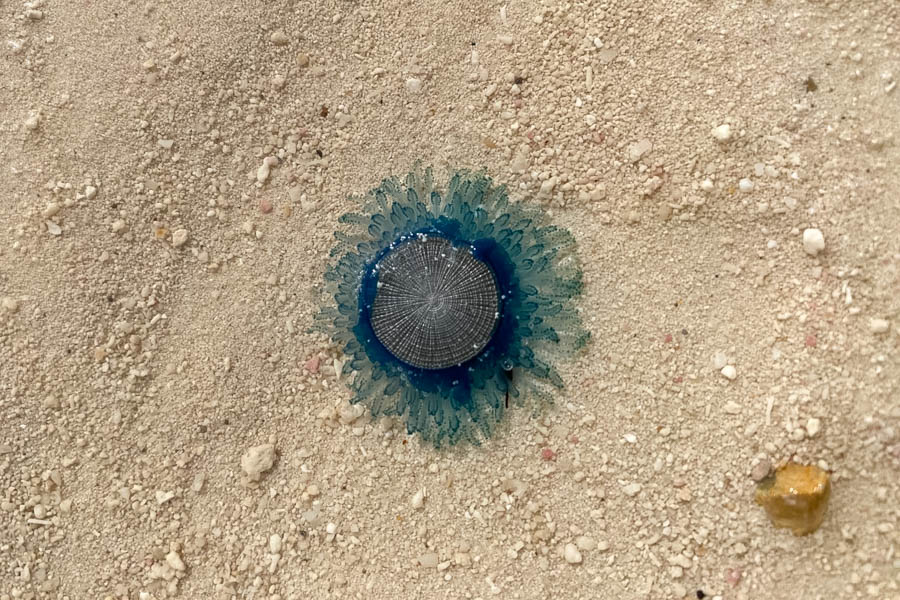
| Name: | Blue Button |
| Scientific Name: | Porpita porpita |
| Similar Species: | Portuguese Man-Of-War (Physalia physalis) |
| Family: | Chondrophores |
| Scientific Family: | Porpitidae |
| Source: | WoRMS AphiaID 117831 |
| Size: | up to 3 in. |
| Depth Range: | In shallow waters (0 – 15 ft.) |
| Sightings: | Not usually seen |
The Blue Button has a small, round, brown center that acts as its float. It has many short, tentacle-like parts around its center. These parts can look bright blue, turquoise, green, or yellow.
The Blue Button lives at the surface and drifts with the water. It may wash ashore after wind or current events. Its sting is usually mild, and contact usually causes mild skin irritation. Rinse the area with seawater, remove any tentacle or colony pieces without rubbing, and soak the sting in hot, but not scalding, water for pain relief.
Blue Buttons can appear with Portuguese Man-of-war, which has a much more painful sting. Blue Button stings are usually much milder. Seek medical help for severe pain, eye exposure, or any whole-body symptoms. Follow first-aid guidance adapted from DAN guidance for Portuguese Man-of-war stings.
Reference: Portuguese Man-of-War (Bluebottle), Divers Alert Network (DAN), View Source