Nassau Grouper
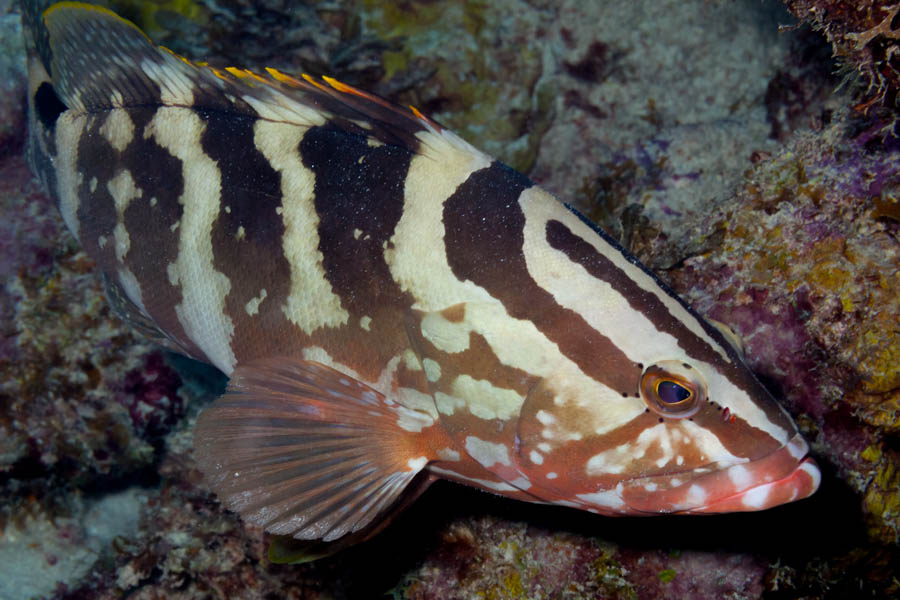
| Name: | Nassau Grouper |
| Scientific Name: | Epinephelus striatus |
| Family: | Groupers |
| Scientific Family: | Epinephelidae |
| Source: | WoRMS AphiaID 159222 |
| Size: | 1 - 2 ft. |
| Depth Range: | On the reef (10 – 60 ft.) |
| Sightings: | Seen rarely |
The Nassau Grouper has a light-colored body with irregular reddish-brown to olive bars and a diagonal band running from the snout, across the eye, to the dorsal fin. It also has a black, saddle-shaped mark at the base of the tail. It can change color to match its surroundings, ranging from pale, nearly white to dark reddish-brown.
This Grouper can be seen alone on the reef near ledges, crevices, and wrecks. It is a daytime predator that ambushes its prey, feeding mainly on smaller fish, crabs, octopus, and young lobsters, and it may live up to 30 years. During reproduction, it migrates long distances to gather in large groups at specific spawning sites. This predictable behavior has made the Nassau Grouper highly vulnerable to overfishing. As a result, the population has declined significantly, and on Bonaire, this Grouper is now seldom seen.