Western Comb Grouper
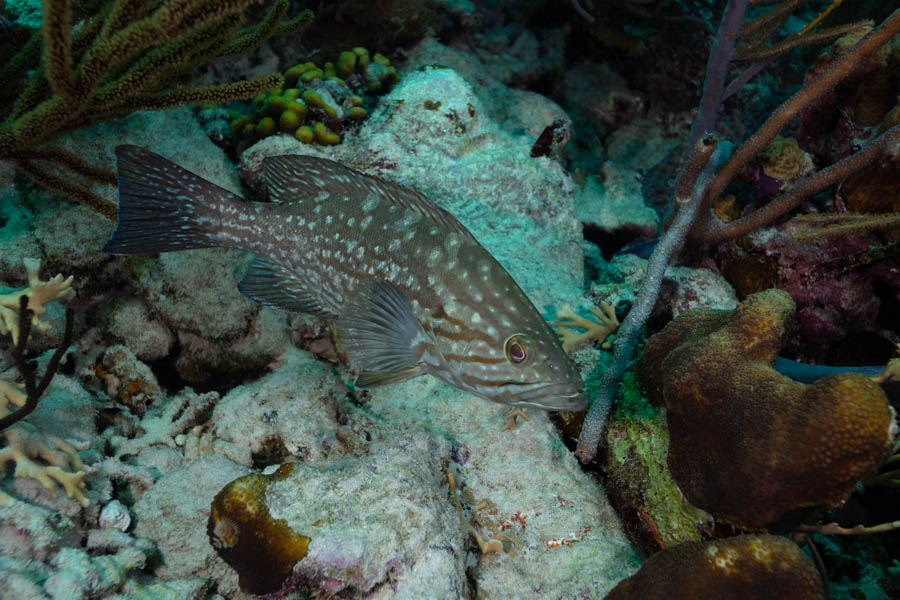
| Name: | Western Comb Grouper |
| Scientific Name: | Mycteroperca acutirostris |
| Family: | Groupers |
| Scientific Family: | Epinephelidae |
| Source: | WoRMS AphiaID 273876 |
| Size: | 1 - 2 ft. |
| Depth Range: | On the reef (10 – 60 ft.) |
| Sightings: | Seen rarely |
The Western Comb Grouper has a gray-brown body covered with small pale blotches. It has a slightly pointed snout and a large mouth with a protruding lower jaw. The dorsal fin is deeply notched, giving it a comb-like appearance. The lower body has irregular dark markings that fade with age, and dark wavy lines extend from behind the eye across the cheek, ending past the gill cover. Its fins are usually darker than its body and may have white spots and streaks.
This Grouper can be found alone on rocky sandy bottoms or on the reef. It is a versatile predator that uses different tactics and is known to lie on its side on the seafloor, pretending to be ill to attract smaller prey. It has also been observed following other species, such as eels, to feed on small crustaceans disturbed by their movements. On Bonaire, large Groupers like the Western Comb Grouper are threatened and declining due to overfishing and habitat loss.