Striated Seahare
| Name: | Striated Seahare |
| Scientific Name: | Stylocheilus polyomma |
| Family: | Seahares |
| Scientific Family: | Aplysiidae |
| Source: | WoRMS AphiaID 1445911 |
| Size: | up to 1.75 in. |
| Depth Range: | In shallow waters (0 – 15 ft.) |
| Sightings: | Seen sometimes |
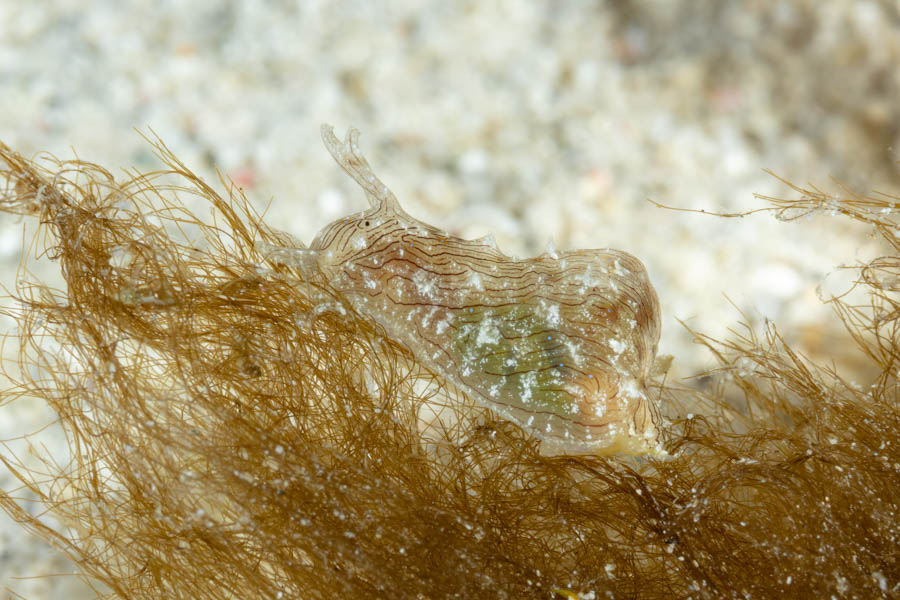
The Striated Seahare has a tan body with blue spots and thin brown lines running across it. There is a large hump in the center of its body. The tail is long, tapering, and has small appendages along its length.
Striated Sea Hares can appear in huge groups when blue-green algae, their food source, is abundant and during reproduction. These blooms may end with many dying at the same time. This can happen after breeding, food loss, or stress. The Striated Seahare can release purple ink from an organ inside its mantle cavity. Its ink is mainly used for defense. It can confuse predators and block their sense of smell.
The western Atlantic Striated Seahare was formerly called Stylocheilus striatus. It is now often called Stylocheilus polyomma, while S. striatus is used for the Indo-Pacific species.