Pipehorse
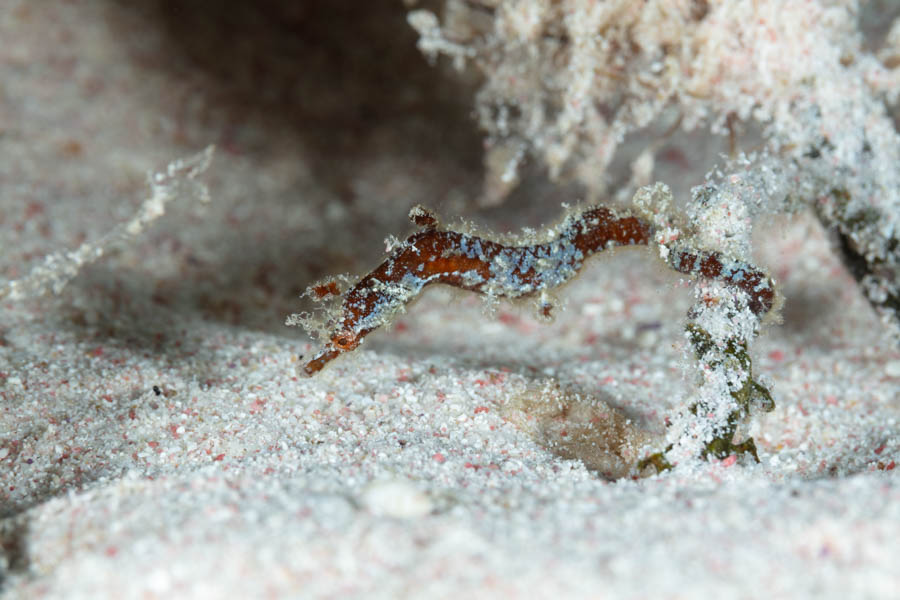
| Name: | Pipehorse |
| Scientific Name: | Amphelikturus dendriticus |
| Synonym: | Acentronura dendritica |
| Family: | Seahorses & Pipefishes |
| Scientific Family: | Syngnathidae |
| Source: | WoRMS AphiaID 316266 |
| Size: | 1 - 2 in. |
| Depth Range: | In shallow waters (0 – 15 ft.) |
| Sightings: | Not usually seen |
The Pipehorse has a slender, segmented body that is covered in distinctive, branching, fleshy projections. Its long, tube-shaped snout and slightly angled head resemble a Seahorse, while its elongated, straight body is similar to a Pipefish. The body is often a mottled mix of colors, typically ranging from light to dark brown or reddish, which helps it blend in with its surroundings.
The Pipehorse is most often seen in shallow, sandy areas, sometimes in pairs, though it can be found deeper on the reef. It has also been observed drifting in open water within large mats of Sargassum seaweed. The Pipehorse feeds by using its long snout to suck up small crustaceans and other tiny invertebrates that float past in the water. Like its relatives, Seahorses and other Pipefishes, the male is responsible for carrying and nurturing the eggs. When the eggs hatch, the juveniles are released into the water to live as part of the plankton before settling.