Striolate Chiton
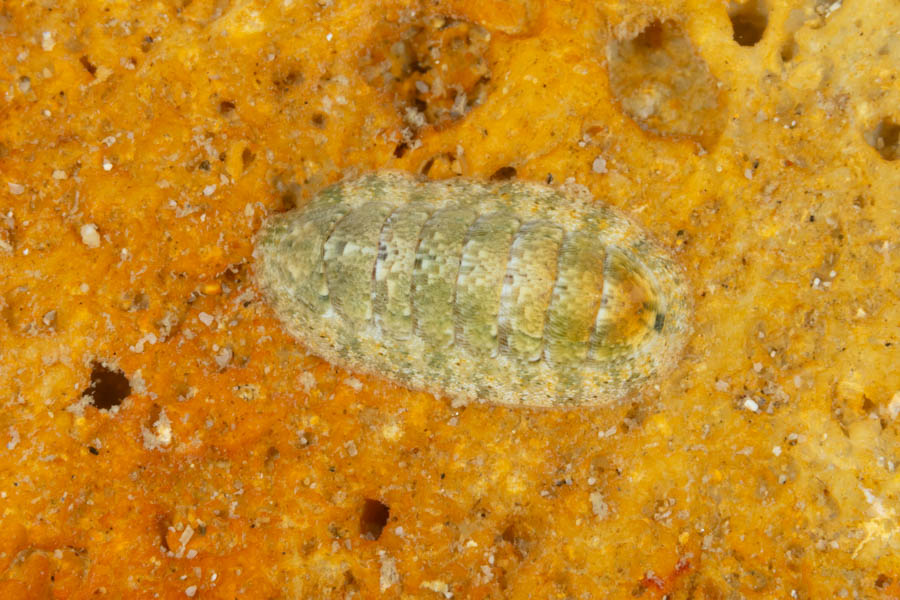
| Name: | Striolate Chiton |
| Scientific Name: | Ischnochiton striolatus |
| Family: | Chitons |
| Scientific Family: | Ischnochitonidae |
| Source: | WoRMS AphiaID 848079 |
| Size: | up to 1 in. |
| Depth Range: | Shorelines, Tidal pools (0 – 2 ft.) |
| Sightings: | Seen often |
The Striolate Chiton has an oval body with eight plates that display faint, wavy grooves arranged in a zigzag or chevron pattern. The outer edge of the body, called the girdle, is decorated with scales or threadlike textures. The colors of this chiton vary greatly, ranging from creamy white, gray, and brown to shades of orange, pink, green, purple, and black.
This Chiton is usually found alone on rocks in shallow coastal areas, where it clings tightly to the hard surface. It is often overlooked because of its small size and ability to blend in with its surroundings. The chiton feeds at night, scraping algae, microorganisms, and small invertebrates from the rock surface with a special rasping tongue called a radula. When dislodged, it can curl into a ball to protect its soft underside.