West Indian Fuzzy Chiton
Fuzzy Chiton
| Name: | West Indian Fuzzy Chiton |
| Scientific Name: | Acanthopleura granulata |
| Family: | Chitons |
| Scientific Family: | Chitonidae |
| Source: | WoRMS AphiaID 386270 |
| Size: | up to 3.25 in. |
| Depth Range: | Shorelines, Tidal pools (0 – 2 ft.) |
| Sightings: | Seen often |
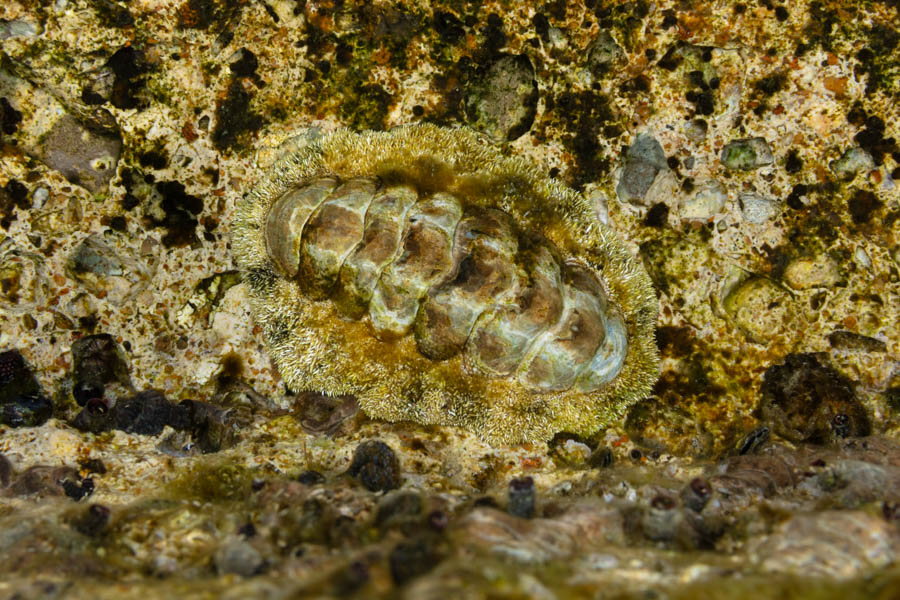
The West Indian Fuzzy Chiton has an oval, stretched shape with eight arched plates on its back. These plates are usually brown but may look smooth or be covered with algae. Around the plates is a part called the girdle. It often has dark stripes and looks fuzzy because of a thick fringe of short, stiff, dark bristles.
The Fuzzy Chiton is usually found clinging tightly to rocks and other hard surfaces in the tidal zone, blending in with its surroundings. It uses its strong, muscular foot to create suction, helping it stay attached even in rough waves. It moves around and feeds at night, scraping algae and other organic matter from rocks with a toothed, tongue-like structure called a radula. The foot of this chiton can be eaten and is sometimes used as fishing bait.