Honeysuckle Tunicate
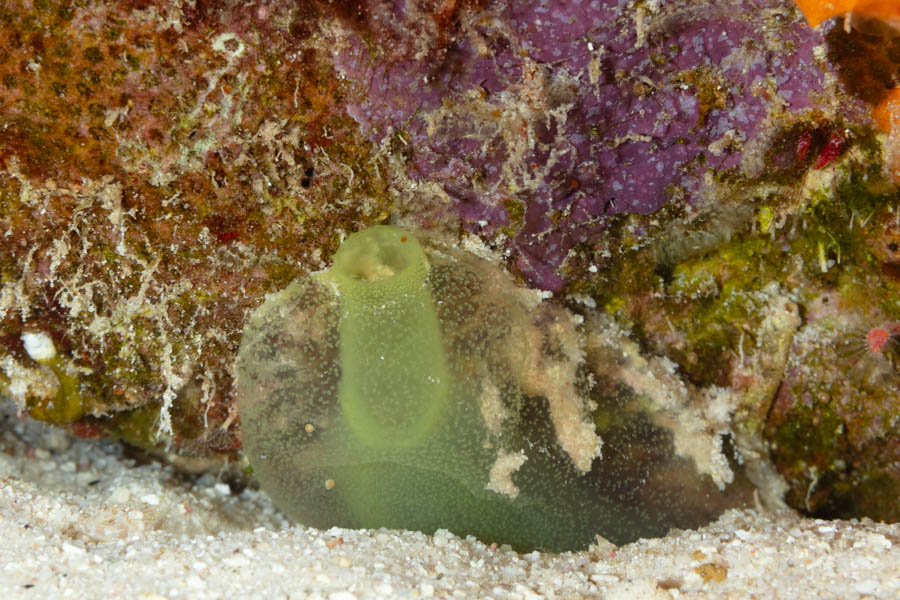
| Name: | Honeysuckle Tunicate |
| Scientific Name: | Perophora viridis |
| Family: | Tunicates |
| Scientific Family: | Perophoridae |
| Source: | WoRMS AphiaID 103761 |
| Size: | up to 0.6 in. |
| Depth Range: | On the reef (10 – 60 ft.) |
| Sightings: | Not usually seen |
The Honeysuckle Tunicate has a greenish, jelly-like body and is translucent, allowing the faint inner lines of its anatomy to be seen. The body is bulbous and rounded, and it connects to other individuals in the colony by a thin, clear stolon or stem.
This Tunicate is typically found alone or in small groups on hard surfaces under ledges and on mangrove roots. As a filter feeder, it draws water into its body through one opening and traps food particles such as bacteria and plankton. It reproduces in two ways. One way is by growing a new individual from the small stem, or stolon, that connects the group. The other way is by releasing tiny, swimming larvae. An interesting fact is its ability to regenerate. Even a small piece of its stem can grow into a new tunicate.