Insular Octopus
| Name: | Insular Octopus |
| Scientific Name: | Octopus insularis |
| Other Names: | Stout Reef Octopus, Common Octopus |
| Similar Species: | Common Octopus (Octopus americanus) |
| Family: | Octopuses |
| Scientific Family: | Octopodidae |
| Source: | WoRMS AphiaID 457762 |
| Size: | up to 3 ft. |
| Depth Range: | On the reef (10 – 60 ft.) |
| Sightings: | Seen sometimes |
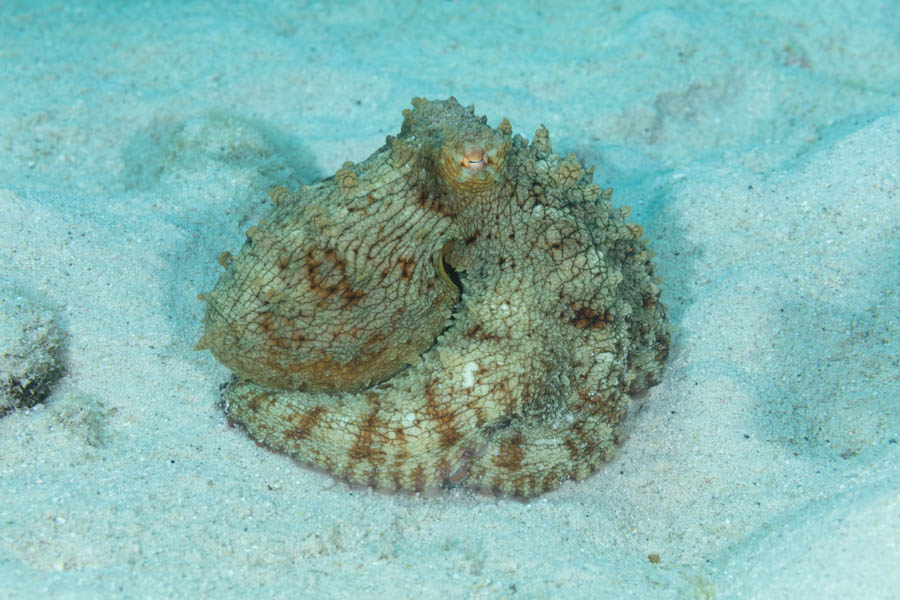
The Insular Octopus has a strong, wide body and short, thick arms. Its skin can look smooth when it moves in open water, but it becomes rough and bumpy when it hides or blends in. It can change color and pattern very quickly. It often shows brown, reddish, cream, or yellowish tones. Its arm undersides may show a clear reddish-brown net-like pattern on a pale background, with dark rings around the suckers. When it is startled, its eye area can turn pale with a dark bar through the eye.
The Insular Octopus lives on hard bottoms, rocks, rubble, tide pools, and seagrass beds. It uses dens for shelter and may move sand, stones, or small objects around the entrance. Empty shells near a hole can be a good sign that an octopus is living there. It is an active daytime hunter, especially in the morning and late afternoon. It moves from place to place, feels inside holes, and catches crabs, shrimp, shellfish, snails, and small fish. It may spread its arms over a small area to trap hidden prey. It can use strong camouflage to hide, signal, or look larger when disturbed. Octopuses are very intelligent, and much of their sensing power is in their arms. The Insular Octopus grows fast, lays many small eggs, and its young drift in the water before settling. The female guards and cleans its eggs until they hatch. It usually stops feeding during this time and dies around the time the eggs hatch.
The Insular Octopus was once confused with the Common Octopus, Octopus americanus, formerly often listed as Octopus vulgaris, but researchers have shown that it is a different, unique species.
Reference: Oxford University Press, Current Zoology, Côrtes et al. (2026), View Source