Longsnout Seahorse
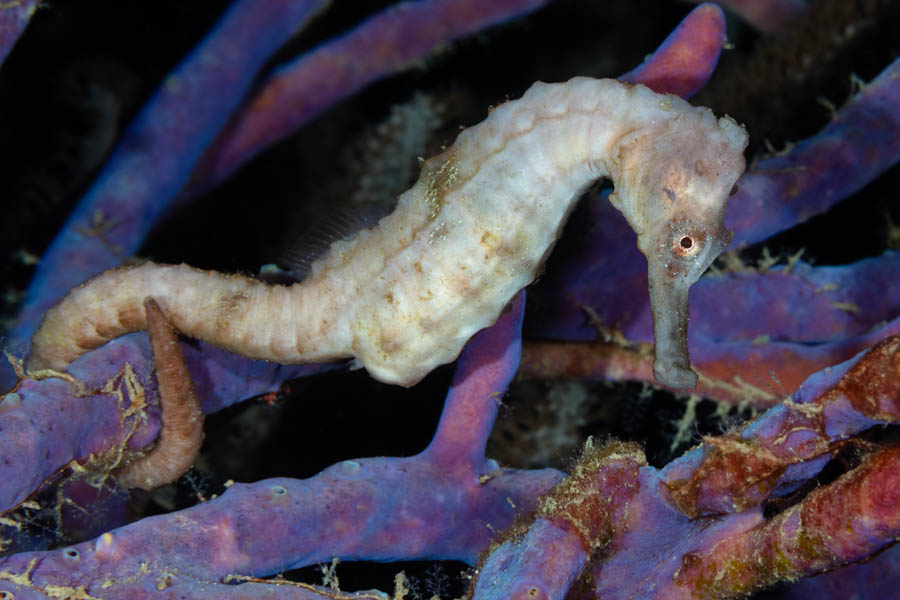
White Longsnout Seahorse
| Name: | Longsnout Seahorse |
| Scientific Name: | Hippocampus reidi |
| Family: | Seahorses & Pipefishes |
| Scientific Family: | Syngnathidae |
| Source: | WoRMS AphiaID 159446 |
| Size: | 2.5 - 4 in. |
| Depth Range: | Various depths (0 – 130 ft.) |
| Sightings: | Not usually seen |
The Longsnout Seahorse has a long snout and a body that ranges in color from yellow to reddish-orange, brown, or black, and may also be two-toned. Its body and head are covered in small black spots, and its dorsal fin has a pale edge. Males have a round, bulging lower belly that gives them a D-shape, while females have a slimmer, narrower body that resembles a P-shape.
This Seahorse is usually found alone, and sometimes in pairs. It can be seen in shallow waters or on the reef, where it holds on to Gorgonians, Coral, or Sponges with its grasping tail. It is not shy and typically remains still when approached, sometimes turning its head away. The Longsnout Seahorse is a stealthy predator, using its long snout like a pipette to suction up tiny crustaceans, which it hunts throughout the day. A unique aspect of its reproduction is that the female deposits her eggs into a pouch just below the male’s abdomen. The male fertilizes the eggs and carries them until they hatch and are released as fully formed juveniles. They are typically monogamous, meaning a pair will mate for life.
Seahorses are magical creatures that many who visit Bonaire want to see. However, they are difficult to find because their populations are small and their camouflage is effective. Therefore, many divers rely on local guides who offer services specifically to locate them. Once a location becomes widely known among divers and guides, a seahorse may receive many visitors each day.